The UK Business Entertainment Tax Myth: What HMRC Lets You Claim (2026/27)
- Red Parrot Accounting Ltd
- 3 days ago
- 5 min read
A client lunch might win your agency a six-figure contract, but that does not make it a tax-deductible expense. This remains one of the most common and costly misunderstandings in UK small business accounting.
Key Rule for 2026/27: HMRC treats client entertainment and staff entertainment under completely different sets of tax laws. Client hospitality is disallowed by default, whereas genuine staff events are usually tax-deductible if specific conditions are met.
This guide breaks down the rules for limited company directors, sole traders, agencies, and small business owners. We explain what HMRC allows, how the £150 annual staff party exemption works, and how to avoid painful VAT traps.
Disclaimer: This article is for general information only and does not constitute formal tax advice. For tailored support, Red Parrot Accounting Ltd provides expert bookkeeping, VAT, and Self Assessment guidance.
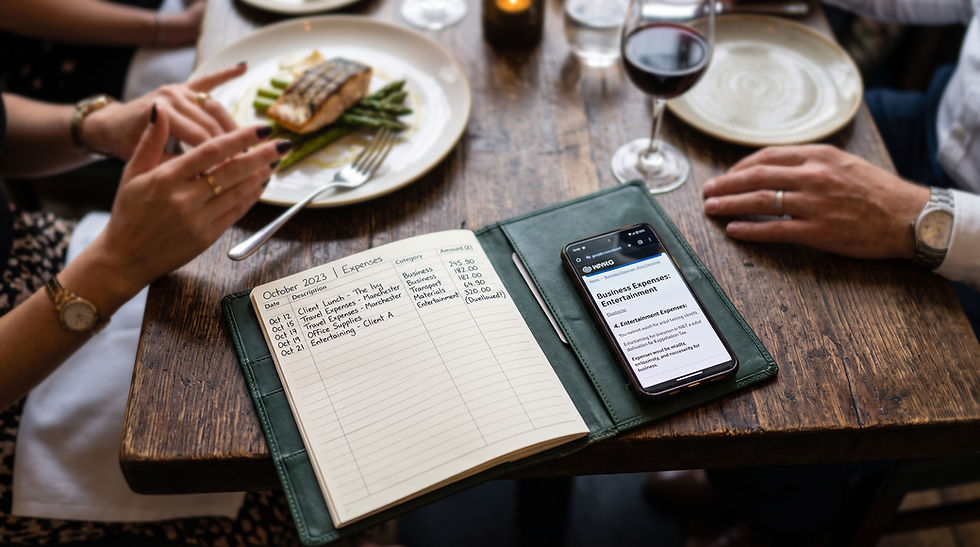
The Client Entertainment Myth That Catches Businesses Out
The myth sounds completely logical:
“If the meal directly helped the business generate revenue, it is an allowable business expense.”
For client entertainment, HMRC explicitly rejects this logic. If you entertain a client, potential prospect, supplier, or business contact, the cost is 0% tax-deductible and carries 0% recoverable VAT, regardless of how commercially vital the meeting was.
What Counts as Client Entertainment?
HMRC looks at the substance of the spend, not the label you give it in Xero or QuickBooks. Renaming a client dinner "marketing," "business development," or "networking" does not alter its tax treatment if non-employees are receiving hospitality.
Common examples of non-deductible client entertainment include:
Taking a prospective client or pitch group out for lunch.
Buying post-meeting drinks for an existing client.
Purchasing corporate hospitality tickets (sports, theatre, concerts).
Providing sandwiches or catering for external guests at your office.
Hotel accommodation or transport provided for a visiting client.
The Tax & VAT Treatment
For Limited Companies: The cost must be added back to profits when calculating Corporation Tax. It gives 0% Corporation Tax relief.
For Sole Traders: The expense is disallowed under Self Assessment trading profit rules.
For VAT-Registered Businesses: Input VAT recovery is legally blocked by HMRC.
Staff Entertainment is Different
Unlike client hospitality, genuine staff entertainment is treated by HMRC as a deductible employee welfare expense.
Allowable Staff Events
If your business pays to entertain genuine employees (people on your PAYE payroll), the costs are usually:
Corporation Tax Deductible: Reduces your taxable company profit.
VAT Recoverable: Input VAT can be reclaimed (provided you hold valid VAT receipts and the event is strictly for staff).
The Mixed-Attendance Trap: If an event genuinely mixes staff and clients, you must apportion the bill by headcount. The staff portion remains deductible and VAT-recoverable, while the client portion is disallowed. However, taking 3 staff members out to dinner primarily to entertain 1 client renders the entire bill disallowed as incidental client hospitality.

The HMRC £150 Annual Staff Party Exemption
Employers can host social functions for staff without triggering a personal Benefit in Kind (BIK) tax bill for employees, provided the event satisfies HMRC’s annual function rules.
The Three Mandatory Conditions
To qualify as a tax-free staff event, the function must meet all three criteria:
It must be an annual function: (e.g., a Christmas party or an annual summer barbecue).
It must be open to all staff: It must be available to all employees generally (or all employees at a specific branch/location).
It must cost £150 or less per head: This threshold includes VAT, catering, drinks, venue hire, entertainment, and linked transport/accommodation.
How to Calculate Cost Per Head
Cost Per Head = (Total Event Spend Including VAT + Transport + Accommodation) ÷ Total Attendees
If a company spends £1,200 on an annual Christmas party for 10 attendees (employees plus guests), the cost is £120 per head—fully exempt.
Beware the £150 "Cliff Edge"
The £150 limit is an exemption, not an allowance. If an annual event costs £151 per head, you do not pay tax on the £1 excess. The entire £151 becomes a taxable Benefit in Kind for each employee, creating Income Tax and Class 1A National Insurance liabilities.
Multiple Annual Events
You can split the £150 exemption across multiple qualifying annual events during the tax year (e.g., a £60 summer event + an £85 Christmas party = £145 total per head). However, if the total exceeds £150, you must choose which whole event fits within the exemption; the remaining event becomes fully taxable.
Sole Traders & Limited Company Director Rules
Tax treatment varies depending on how your UK business is legally structured.
Sole Traders
As a sole trader, you and your business are legally the same entity. You are not an employee.
Personal meals during a standard working day are private living expenses and cannot be claimed.
Client meals remain strictly disallowed.
You can only claim food and drink as travel subsistence when conducting genuine business travel outside your normal work routine.
Sole-Director Limited Companies (The VAT Trap)
Company directors are official office holders and are classed as employees for tax purposes. A sole-director company can use the £150 annual function exemption for its director-only Christmas dinner to avoid Income Tax/BIK charges.
However, watch out for the Director VAT Trap:
HMRC guidelines specifically block input VAT recovery on entertainment provided only to directors, partners, or sole proprietors where no other non-director staff attend. HMRC argues that directors do not need to "motivate or reward" themselves.
Result: A sole-director company can claim Corporation Tax relief and Income Tax exemption on a £140 annual dinner, but must not reclaim the input VAT on the invoice.

Travel Subsistence vs. Business Entertainment
It is easy to confuse travel subsistence with business entertainment, but HMRC treats them completely differently.
Travel Subsistence (Allowable): Reasonable food and drink purchased while you or your employees are undertaking qualifying business travel (e.g., visiting an out-of-town client site or attending a conference overnight). This feeds the worker on the road.
Business Entertainment (Blocked): Buying food, drink, or hospitality for a client or prospect. This provides hospitality to non-employees.
Buying yourself a sandwich while travelling to a client meeting in another city is allowable subsistence. Paying for the client's lunch at the same meeting is disallowed entertainment.
Summary Comparison Matrix
Expense Category | Corporation Tax / Self Assessment Relief | VAT Recovery | Benefit in Kind (BIK) Status |
Client / Prospect Meals | 0% (Not Allowable) | 0% (Blocked) | No BIK for client |
Staff Party (≤ £150/head, All Staff) | 100% Allowable | 100% Recoverable | Exempt (No tax/NI) |
Staff Party (> £150/head) | 100% Allowable | 100% Recoverable | Taxable BIK on full amount |
Director-Only Annual Dinner | 100% Allowable | 0% (Blocked by HMRC) | Exempt (If ≤ £150/head) |
Travel Subsistence (Qualifying) | 100% Allowable | 100% Recoverable | Exempt (Not a benefit) |
Best Practices for Booking & Coding Entertainment
To ensure your accounts pass an HMRC audit, follow these simple bookkeeping rules:
Create Separate Chart of Account Codes: Do not throw all restaurant receipts into a single "Meals & Subsistence" account. Maintain distinct accounts for Client Entertainment (Disallowed), Staff Entertainment, Annual Staff Functions, and Travel Subsistence.
Annotate Every Receipt: Write down who attended, their business relationship (employee vs. client), and the business purpose directly on the receipt or digital upload note.
Track Staff Party Headcounts: Keep a record of the guest list (employees and partners) for annual functions to mathematically prove you remained under the £150 limit.
Final Pre-Filing Checklist
[ ] Separated non-deductible client entertainment from allowable staff expenses
[ ] Verified that staff annual functions are open to all employees
[ ] Confirmed total cost per head for annual staff events is £150 or under (including VAT/transport)
[ ] Blocked VAT recovery on director-only social events
[ ] Kept itemised VAT receipts and travel notes for all qualifying subsistence claims
Let Red Parrot Accounting Ltd Keep Your Business Compliant
Coding entertainment incorrectly in your accounts can lead to backdated Corporation Tax assessments, HMRC interest penalties, and clawed-back VAT. Red Parrot Accounting Ltd helps UK businesses set up clear, compliant bookkeeping systems in Xero and QuickBooks. Contact our team today to review your business expenses and optimize your tax strategy.


Comments