Sole Trader Invoice Rules UK: Payment Terms and Late Payment Recovery Guide
- redparrotuk789
- Jul 29
- 5 min read

Late payment is not just irritating. For a sole trader, it can mean covering materials, tax, fuel, software, subcontractors, and living costs while someone else holds on to money already earned.
A clear invoice will not stop every late payer, but it gives a firm legal and commercial starting point. It tells the client what they owe, when they must pay, and what happens if they do not. This guide explains UK sole trader invoicing rules, common payment terms, and the lawful steps available when business customers pay late.
Disclaimer: This article provides general information and does not constitute legal or financial advice. For disputed debts, consumer issues, or court claims, seek advice based on the specific facts of your case.

1. What a Sole Trader Invoice Must Include in the UK
A sole trader invoice should be clear enough for the client, HMRC, and a court to understand. It must clearly identify who issued it, who must pay it, what the work was, and how much is due.
Essential Invoicing Checklist:
Your Full Legal Name: Use your real name as the self-employed individual. If you trade under a business name, include both (e.g., "Alex Patel trading as AP Electrical Services").
Your Trading Name: Show it clearly if used. Do not invoice using a limited company name unless the business is legally incorporated at Companies House.
An Official Address for Legal Documents: The physical address where formal letters and legal notices can be delivered.
Unique Sequential Invoice Number: Each invoice needs its own number in a continuous sequence (e.g., INV-001, INV-002, INV-003). Avoid duplicating numbers or using random codes.
The Invoice Date: The exact date the invoice is issued.
The Supply Date: The date goods or services were supplied, if different from the invoice date (e.g., project completion date).
Description of Goods or Services: Be specific. "Website support for March" or "Bathroom tiling labour and materials" is far stronger than vague phrases like "work done".
Total Amount Due: Show the final price clearly. Itemise materials, expenses, or hourly charges if applicable.
VAT Details (If VAT Registered): Include your VAT registration number, the applicable VAT rate, the VAT amount, and the total including VAT. If not VAT registered, do not charge VAT.
Summary: Sole Trader Invoice Elements
Invoice Section | What to Include |
Seller Details | Full legal name, trading name (if used), address for legal documents |
Client Details | Client name, business name, billing address, contact email |
Invoice Details | Sequential invoice number, invoice issue date, supply date |
Work Breakdown | Clear description, hours or quantity, unit rate, subtotal |
VAT Details | VAT registration number, VAT rate, itemised VAT amount (if registered) |
Payment Details | Total amount owed, due date, bank details / direct payment link |
Payment Terms | Payment window, late payment interest terms, recovery cost statement |
2. Payment Terms for Sole Traders in the UK
Payment terms set the deadline for when a client must settle their bill. Setting clear payment terms before starting work ensures there is no room for misinterpretation.
Standard Commercial Terms
Net 14 Days: Payment is due 14 calendar days from the invoice date. Ideal for smaller jobs, trades, short projects, and freelancers needing steady cash flow.
Net 30 Days: Payment is due 30 calendar days from the invoice date. This is the corporate standard across larger business customers, agencies, and public sector bodies.
The 30-Day Statutory Default Rule
If no specific payment date is agreed in a business-to-business (B2B) contract, UK law provides a statutory default. Payment is legally treated as overdue after 30 days from the later of:
The date the client receives your invoice, or
The date the goods or services were delivered.

3. Late Payment Rights for B2B Invoices
For commercial debts, the Late Payment of Commercial Debts (Interest) Act 1998 gives sole traders an automatic legal right to claim statutory interest and fixed debt recovery compensation when another business pays late.
1. Calculating Statutory Late Payment Interest
Under UK law, statutory interest on commercial debts is set at 8% above the Bank of England base rate.
Current Rate Calculation:
Bank of England Base Rate (3.75%) + Statutory Addition (8.00%) = 11.75%
(Note: Always check the active Bank of England base rate on the date your invoice becomes overdue).
The Interest Formula:
Interest Owed = (Debt Amount × Annual Rate ÷ 365) × Days Overdue
Worked Example: An overdue B2B invoice for £2,000 that is 30 days late at an 11.75% statutory rate:
(£2,000 × 0.1175 ÷ 365) × 30 = £19.32 Interest
2. Fixed Debt Recovery Compensation
In addition to daily interest, UK law lets you charge an automatic fixed sum to cover debt recovery costs on qualifying B2B invoices:
Overdue Invoice Value | Allowable Fixed Compensation |
Up to £999.99 | £40.00 |
£1,000.00 to £9,999.99 | £70.00 |
£10,000.00 or more | £100.00 |
If your reasonable recovery costs exceed the fixed compensation amount (e.g., debt collection or legal fees), you may claim the reasonable difference.
4. B2B vs Consumer (B2C) Enforcement: Key Differences
Do not confuse business debt collection rules with consumer rules.
Business-to-Business (B2B): Covered automatically by the Late Payment of Commercial Debts (Interest) Act 1998. Statutory interest and fixed compensation can be applied automatically once overdue.
Business-to-Consumer (B2C): Covered under the Consumer Rights Act 2015. Terms must be fair, transparent, and balanced. You cannot apply automatic statutory business penalties or 11.75% interest to private individuals unless fair, explicit late payment terms were agreed in writing before starting the work.
5. A Practical Process for Recovering Overdue Payments
Late payment recovery works best when it is calm, documented, and executed in stages:
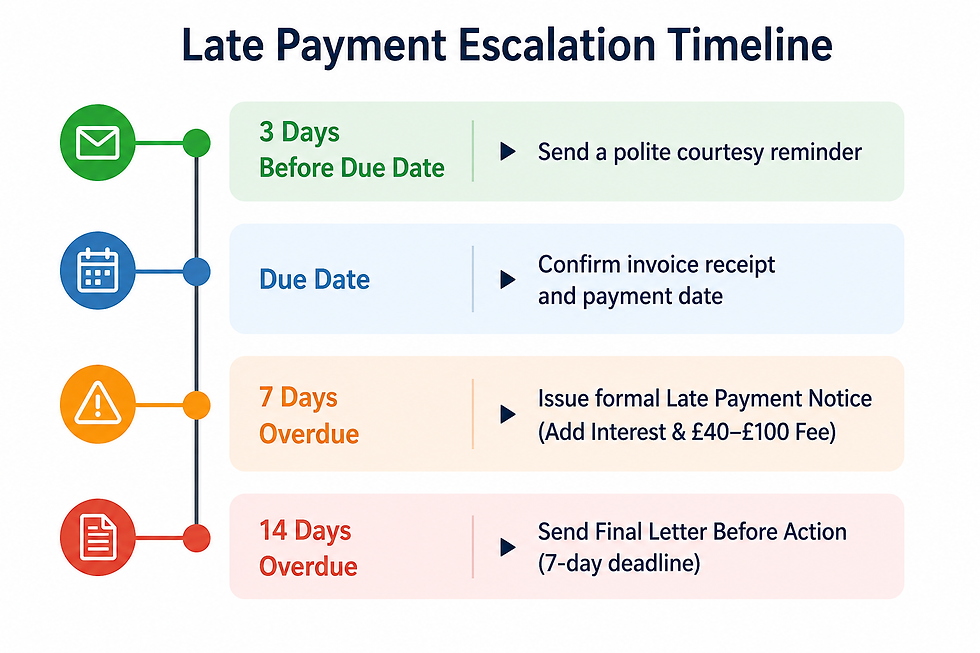
Send a Polite Reminder (3 Days Before): A quick courtesy email with a direct payment link prevents accidental oversights.
Chase Immediately (Day After Due Date): Maintain a professional tone while establishing that your payment deadlines matter.
Issue a Formal Late Payment Notice (7 Days Overdue): State that statutory interest and fixed recovery compensation now apply under the 1998 Act. Include an itemised calculation.
Issue a Final Demand / Letter Before Action: Give a final 7-day deadline before pursuing formal recovery (such as a county court small claim or third-party debt collection).
6. How to Prevent Late Payments Before They Happen
Take Up-Front Deposits: Secure a 25% to 50% deposit before purchasing materials or starting major projects.
Embed Direct Payment Links: Include "Pay Now" card links or Open Banking shortcuts on digital PDFs to eliminate payment friction.
Automate Invoice Reminders: Let accounting software (e.g., FreeAgent, Xero, QuickBooks) handle scheduled email reminders automatically.
Include Explicit Invoice Statements: Add standard protective wording to all quotes and invoices:
"Payment Terms: Net 30 Days. For business customers, overdue invoices attract statutory interest at 8% above the Bank of England base rate plus fixed compensation for recovery costs under the Late Payment of Commercial Debts (Interest) Act 1998."
Struggling with Overdue Invoices or HMRC Compliance?
Getting paid on time and keeping accurate business records is essential for every self-employed UK business owner.
Whether you need support setting up automated invoicing systems, claiming allowable expenses, or ensuring your Self Assessment return is audit-proof, our team is here to assist you.
Contact Us Today to discover how we can help protect your cash flow and keep your finances stress-free!


Comments